General

Today’s Patron Saint

Posted in General, On This Day on April 15th, 2011 by Eugene Finerman – Be the first to comment

April 15th is both the income tax deadline and the feast day for the patron saint of laundresses. Either way, you get taken to the cleaners. Since you probably know the IRS more than you wish, let me introduce you to St. Hunna. She was a German noble of the seventh century who turned her fetish into a sainthood. Hunna liked to wash the poor.

Everyone in 7th century Western Europe was filthy.  Hunna’s fellow nobles were just as feces-encrusted as the peasants, but at least they could not be bullied by a shrew with a wash rag. The poor, however, were in no position to refuse Lady Hunna. Let’s hope that she coaxed them rather than terrorized them. “I’ll give you a slice of bread if you let me bathe you.” (Footnote for our younger or unattached readers: this is a lousy pickup line. At least offer a whole pizza.)

Soap had yet to be introduced into Europe; those decadent Moslems were inventing it at this time. So Hunna’s method of washing would have been limited to soaking and scraping. She would have washed a body the way that we would clean a pan. The miserable but clean poor: I don’t know if any of them became saints, but they all were martyrs.

Considering how many psychopaths and pyromaniacs have been canonized, Hunna’s fetish does seem comparatively holy. Happy Saint Hunna’s Day to you all.

Titanic Disproves Global Warning!

Posted in General, On This Day on April 14th, 2011 by Eugene Finerman – Be the first to comment
Apr 14, 1912:

RMS Titanic hits iceberg

April 14, 2011

Geraldo Rivera Vows to Find Iceberg.

“Maybe that iceberg is passing itself off as a Canadian igloo.  Maybe it fled to Antarctica, but I think that it is still out there lurking and ready to strike again.  I’ll find it and bring it to justice.”

Who Really Sank the Titanic

House Republicans Look For Culprits

Following a three-hour explanation by Eric Cantor that Iceberg is not necessarily a Jewish name, House Republicans demanded that the Public Broadcasting System should be defunded for its role in the ship’s sinking.  As proof, the scripts of “Upstairs, Downstairs” were read into the Congressional record.  Congressman Louis Gohmert of Texas also condemned the name “Titanic” for being a dirty word.

Senate Republicans Look for Culprits

An indignant Mitch McConnell wanted to know why any First Class passengers had drown.  “If they didn’t pay for a lifeboat, who did!”  The Senate then passed an unanimous resolution of apology to the Astor family.  The apology resolution to the Vanderbilts passed 70 to 30 when it was revealed that Anderson Cooper was related.  The apology resolution to the Strausses was 60 to 40; apparently their name sounded too much like iceberg.

p.s.  Aside from that, Mrs. Lincoln, how did you like the play: https://finermanworks.com/your_rda_of_irony/2010/04/14/irony-in-two-acts/

History For Fun, Profit and Evil

Posted in General, On This Day on April 13th, 2011 by Eugene Finerman – Be the first to comment

Donald Trump Questions Obama’s Citizenship

Now Sending ‘Investigators’ To Hawaii

If you want to  revoke President Obama’s citizenship just revoke Hawaii’s.   It might be a little embarrassing to the McKinley administration, but the United States had no right to the Hawaiian Islands and knowingly accepted stolen property.  That is why President Grover Cleveland refused to annex the territory when it was first offered in 1893 by the American businessmen who had overthrown the Hawaiian monarchy and seized control of the islands.  

Of course, Cleveland was a Democrat and couldn’t distinguish the difference between thieves and entrepreneurs.  William McKinley evidently could.  (A thief takes a pineapple; an entrepreneur takes the entire island.) He welcomed the offer and accepted Hawaii as an American territory in 1898.  However, now that has proved inconvenient and so America should return the islands to the royal house of Del Monte.  And incidentally, with Hawaii’s postdated sovereignty going back to 1893, Barak Obama would really have been born in a foreign country.

President Trump will probably appoint me to the Supreme Court.

p.s.  Let’s not forget the historic significance of this day:  https://finermanworks.com/your_rda_of_irony/2010/04/15/overdue-books/

Flagging Efforts

Posted in General, On This Day on April 12th, 2011 by Eugene Finerman – 1 Comment

April 12th

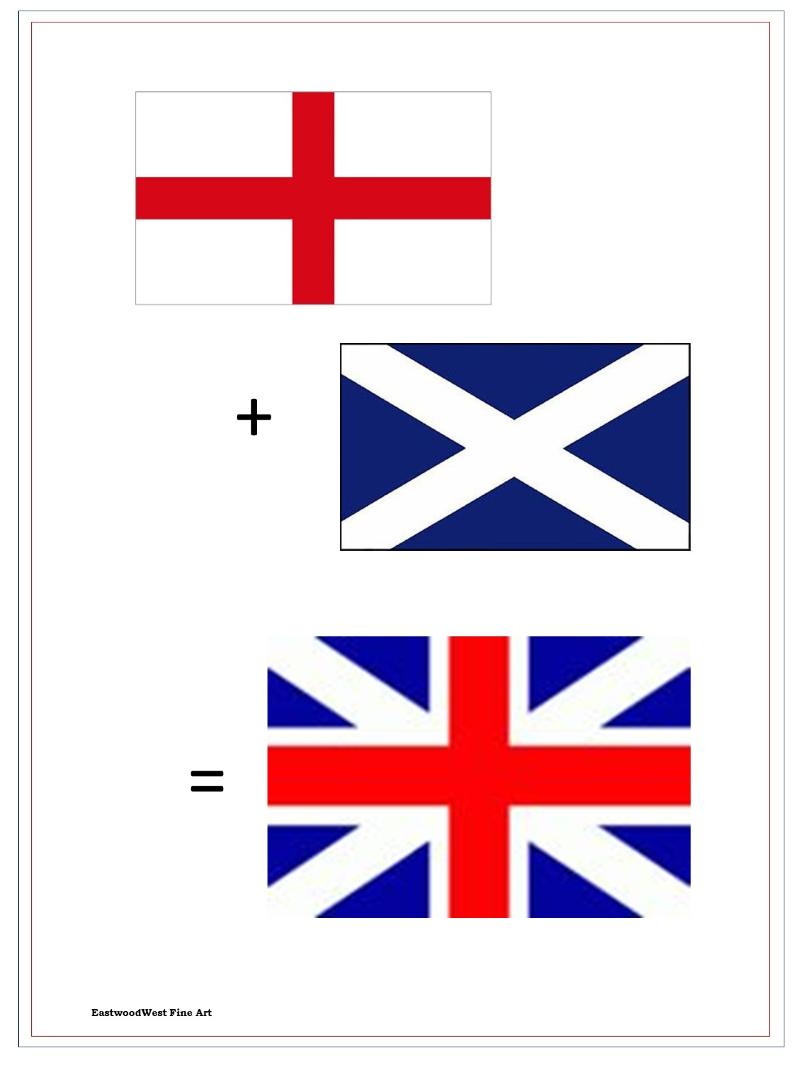
UK flagWhat happens when you combine a Greek and a Jew? You either get 241 jokes about lawyers or the flag of Great Britain. Since I have writer’s block, I will skip the 241 jokes and just give you the history of the Union Jack.

Until April 12, 1606, the flag of England was ostensibly the “cross of St. George”, two straight red lines transecting on a white background. St. George was the patron saint of England, although you can hardly imagine a cosmopolitan 4th century Greek bishop visiting the backwoods of Britannia.

Until April 12, 1606, the flag of Scotland was ostensibly “the cross of St. Andrew”, two white diagonal lines intersecting on a blue background. St. Andrew was the patron saint of Scotland, although you could be certain that an illiterate first century Jewish fisherman never heard of Caledonia.

On April 12, 1606, however, the two flags were combined, because both country were ruled by James, England’s first and Scotland’s sixth. King James was somewhat brighter than the average Stuart and considerably shorter, but he had the full extent of Scottish parsimony. (Being cheap did spare him a conflict over money with Parliament; his son should have been so stingy.) He probably thought that combining the two flags would save on fabric.

The flag soon was named the Union Jack, an allusion to the fact that the Latin form of James is Jacobus, alias Jack. Initially, the Union Jack was the monarch’s personal banner. England and Scotland continued to fly their respective “crosses.” But in 1707, someone kept Queen Anne sober enough to sign the Act of Union, combining Scotland and England into one country and under one flag.

In 1801, the Union Jack’s appearance was “freshened” and updated with the addition of a red sash of intersecting diagonal lines: “the cross of St. Patrick”. (St. Patrick was the patron saint of Ireland and, in an unprecedented coincidence, he really had been there.) You can just imagine just how thrilled the Irish were to be be represented on the Union Jack.

Wales, however, is excluded from the Union Jack. Its “cross of St. David” is two straight yellow lines transecting on a black background. Wales might have stayed independent if its soldiers had clashed as ferociously as its color scheme.

But ‘Twas a Famous Victory

Posted in General on April 11th, 2011 by Eugene Finerman – 2 Comments

King Juan Carlos has probably exhausted himself opening all those anniversary cards, congratulating him on the  Treaty of Utrecht.  On this day in 1713, Great Britain and some of her allies acknowledged that the Spanish Bourbons were on the throne in Madrid, and there was not a thing they could do about it. Of course, they certainly had tried–as you might gather from the name “The War of the Spanish Succession.”

In 1700, King Charles II of Spain died. The man had been a genetic experiment: how many generations of first-cousins’ marrying will it take to produce a hopeless mess. The answer is five: and Charles II was deformed, crippled and–even by royal standards–mentally retarded. Mercifully, he also was impotent. When he died (lasting somehow until he was 38), he had no living siblings to succeed him: the Spanish Hapsburgs were extinct. However, his older half-sister had married Louis XIV–and impotence was never Louis’ problem. So Charles’ nearest relatives were French, and you can imagine how thrilled Britain was with the idea of Bourbon Spain.

Of course, the Austrian Hapsburgs wanted to keep Spain and her Empire within the family, and they could offer a second cousin to succeed Charles. That was good enough for Britain. France, however, had somehow coaxed Charles into acknowledging his great-nephew (and Louis’ grandson) as his heir. (Can you draw a horsie? Just use this piece of paper with these funny words on it.) The French had the succession in writing and, with the advantages of proximity, the French prince could be enthroned in Madrid long before Charles’ obituary had reach Vienna.

Britain and Austria did not recognize this fait accompli (which unfortunately is a French term) and the result was The War of Spanish Succession. The war lasted from 1701 to 1714 (the Austrians pouting for an extra year after the Treaty of Utrecht) but the outcome is rather bewildering. The Allies won the major battles–Ramilles, Oudenarde, Turin and Blenheim (the only one still remembered), and sea divers today are having a wonderful time finding the wrecks of French and Spanish fleets; yet, judging from the map, the French won the war.

The grandson of Louis XIV became Philip V of Spain and that vast empire encompassing most of the western hemisphere. For consolation, the Austrian Hapsburgs received Belgium and Northern Italy. (The latter might be regarded as a musical triumph, providing Viennese opera with castrati.) Britain was ceded its first territory in Canada–complete with thousands of disposable Acadians–and a Spanish outpost called Gibralter. The fruits of victory were prunes. In fact, the war could have ended in 1706; France offered the same trivial concessions then.

In 1706, however, the Whigs controlled Parliament and–more importantly–Queen Anne’s liquor cabinet. Their policy was perpetual war with France, at least until Notre Dame was an Anglican church. But Britain faced a succession crisis, too. Anne had no surviving children (an indictment of the era’s pediatrics) and she personally hoped that her her half-brother James would succeed her. He was her nearest relative, but James was a Catholic and a pensioner of France; so he wasn’t a favorite of the Whigs. The Tories were more sympathetic to exiled James, at least that is what they told Queen Anne. In 1710, an unusually conscious Anne ousted the Whigs from her cabinet and replaced them with those ingratiating Tories.

By 1711, Britain and France had an understanding. The two countries had a truce and France was to take a lethargic approach to fighting Austria. No marching to Vienna! (This way the Britain did not feel guilty about abandoning its ally.) Even with this shameless collaboration, it still took two years to agree on a treaty. The Tories could not look too eager for peace; they certainly could not surrender the territories–Belgium and Northern Italy–that the allies had won. No, those would be Austria’s pittances. Furthermore, France had to promise not to merge with Spain. (And the 77 year-old Louis might have personally pledged to refrain from doing the flamenco.) Yes, the Treaty of Utrecht only lacked a few syphilis jokes to be a Restoration Comedy. Queen Anne had to grant titles to a dozen Tory hacks to ensure that the Treaty would pass the House of Lords.

Anne died in 1714. Despite her wishes, Tory sympathies and French support, she was not succeeded by her Catholic half-brother. The Stuart prince had no sense of timing or initiative; he did not even show up in Britain to claim his throne until 1715. George I had been coronated the previous year. So much for the War of the English Succession.

Since 1713, the British probably have gotten over the shame of the Treaty of Utrecht. (The outcome of The Seven Years War would have pleased the Whigs.) Nevertheless, Juan Carlos cannot have Gibralter back.

Eugene’s Latest Fixation

Posted in General on April 5th, 2011 by Eugene Finerman – Be the first to comment

More Borgia musings….

If “Vatican Hill 90210” turns out to be popular, I wonder how Showtime will stretch the series out to ten or twenty years.  If I recall, the network extended “The Tudors” by giving Henry 47 wives.  (I think the last was Sophie Tucker–the series/dynasty always needed some Jewish humor.)  My guess is that Leonardo invents a time machine, so it turns out Silvio Berluscone is actually Alexander VI.  (Yes, our favorite Borgia was also Casanova and Giocomo Puccini.)

In the meantime, Showtime could have a commercial tie-in with Seven-Eleven or Dairy Queen.  Big Gulps or Blizzards could be served in chalices, each featuring a member of the Papal conclave of 1492.  Get the entire collection!

Rodrigo de Borja y Borja, bishop of Porto e Santa Rufina, administrator of Valencia, dean of the Sacred College of Cardinals. (Elected Pope Alexander VI)
Giuliano della Rovere, bishop of Ostia e Velletri, bishop of Bologna, administrator of Avignon.
Oliviero Carafa, bishop of Sabina, title of S. Eusebio in commendam, administrator of Salamanca.
Giovanni Battista Zeno, bishop of Frascati.
Giovanni Michiel, bishop of Palestrina, deaconry of S. Angelo in Pescheria in commendam.
Jorge da Costa, bishop of Albano, title of S. Lorenzo in Lucina in commendam, archbishop of Lisbon, Portugal.
Girolamo Basso della Rovere, title of S. Crisogono, bishop of Recanati e Macerata.
Raffaele Sansoni Riario, title of S. Lorenzo in Damaso.
Domenico della Rovere, title of S. Clemente, archbishop of Turin.
Paolo Fregoso, title of S. Sisto, archbishop of Genoa.
Giovanni de’ Conti, title of S. Vitale.
Giovanni Giacomo Schiaffinati, title of S. Cecilia, bishop of Parma.
Francesco Todeschini-Piccolomini, deacon of S. Eustachio, bishop of Siena.
Giovanni Battista Savelli, deacon of S. Nicola in Carcere Tulliano.
Giovanni Colonna, deacon of S. Maria in Aquiro.
Giovanni Battista Orsini, deacon of S. Maria Nuova.
Ascanio Maria Sforza Visconti, deacon of Ss. Vito e Modesto.
Lorenzo Cibo de’ Mari, title of S. Marco, archbishop of Benevento.
Ardicino della Porta, iuniore, title of Ss. Giovanni e Paolo, bishop of Aleria, Corsica.
Antoniotto Gentile Pallavicini, title of S. Prassede, bishop of Orense, Spain.
Maffeo Gherardo, O.S.B.Cam., title of Ss. Nereo ed Achilleo, patriarch of Venice.
Giovanni de’ Medici, deacon of S. Maria in Domnica.
Federico di Sanseverino, deacon of S. Teodoro.

This is the actual list, which I found on a fascinating (for me, anyway) website:  http://www2.fiu.edu/~mirandas/conclaves.htm

“The Cardinals of the Holy Roman Church” ain’t exactly an objective title, but it is a comprehensive catalog of every papal enclave.  Just pick any papal election in the 12th, 15th and 19th centuries;  you’ll find the Orsini, Conti and Colonna families were producing a supply of cardinals.  (Since the 20th century, however, Italian aristocrats found it more lucrative to marry American heiresses.)

p.s.  Let’s not forget the historic significance of this day:  https://finermanworks.com/your_rda_of_irony/2009/04/05/how-to-lose-a-battle-in-a-spectacular-way/

The Borgia Report

Posted in General on April 4th, 2011 by Eugene Finerman – 3 Comments

Ave Deus for the Middle-Aged.  Otherwise, The Borgias would be “Vatican Hill 90210” with a cast of quite annoying youngsters.  Yes, the nude scenes of the English actress playing Lucretia won’t be painful–although by the 47th time they may get monotonous.  But Cesare seems more smarmy than ruthless, and I am trying to use my HD television to murder the preening twit playing Juan Borgia.  (I keep lunging at him but I can’t quite get through the TV screen; I am complaining to Comcast!)  However, the series has the saving disgrace of Jeremy Irons–and he is more than enough reason to keep watching.  In Iron’s  portrayal of  Pope Alexander VI and the father of the Borgia brood, you can feel both the pleasure and the hard work of being thoroughly corrupt. 

Of course, in keeping with television’s exacting standards for historical accuracy, the show is a litany of errors.  The series doesn’t even get right the number of the Pope’s children.  Showtime seems determined to present the Borgias as the Renaissance Corleones; so if Vito only had four children, then Pope Alexander can’t have more than that.  In fact, he had at least six–with two mistresses.  (A seventh is in dispute because a third mistress was also “dating” her husband.)  The series also scrambles the chronology of the Borgia brats.    Cesare is introduced as the firstborn; actually, the incompetent Juan was.  So much for the belabored Godfather metaphors; the Machiavellian Michael Corleone was younger than the reckless Sonny.    But I am still waiting to see if Leonardo daVinci is compared to Frank Sinatra, and if the Pope backs Columbus’ plan to discover Las Vegas.

More Borgia gossip, from the archives:  https://finermanworks.com/your_rda_of_irony/2009/08/11/machiavellis-role-model-2/

And, for a change of pace, here is today’s  saint:  https://finermanworks.com/your_rda_of_irony/2010/04/05/the-patron-saint-of-wikipedia/

The Fool’s Guide to History

Posted in General, On This Day on April 1st, 2011 by Eugene Finerman – 2 Comments

 Did man evolve from the lemming?  History often seems to be a road map to a cliff. On April Fools’ Day, we should remember the colossal buffoons who have shaped and sabotaged our world. Their profound stupidity remains our legacy. If only for therapeutic revenge, we hereby recount their calamitous lives. The culprits are in chronological order.

– – – – – – – – – – – – – – – – –

Andronicus Ducas, 1071 A.D.

Andronicus Ducas became the inadvertent father of Turkey and the Crusades. The Byzantine general simply wanted to kill his emperor but was too finicky for an assassination. Ducas waited until the imperial army was fighting Turkish nomads and then ordered a retreat, abandoning the emperor to the enemy. The general overestimated the army’s ability to retreat, however. It disintegrated, leaving Anatolia — half the empire — defenseless. The Turks weren’t nomads after that. Anatolia is now called Turkey. The Moslem triumph ignited the Crusades, and its hordes of pious killers destroyed what was left of Byzantium.

– – – – – – – – – – – – – – – – –

Emperor Yung-lo, circa 1415 A.D.

China declared an end to progress. Emperor Yung-Lo had the best of everything. He ruled the most powerful, most prosperous, most technically advanced, most populous country in the world. At a time when English ships never sailed farther than Portugal, the Chinese fleet was exploring East Africa. Considering China’s extravagant superiority, Yung Lo decided that there was no point to improving on perfection. The rest of the world had nothing to offer China. Yung Lo abolished the fleet, discouraged trade and promoted a tradition-bound regimen of education. Yung Lo’s policy lasted for six centuries and so did China’s stagnation.

– – – – – – – – – – – – – – – – –

Ferdinand of Aragon, 1483 A.D.

The king actually was bright and completely free of scruples; Machiavelli considered him a role model.  However, Ferdinand turned out to be a little too clever.   

He had a get-rich-quick scheme. The wily and avaricious king commissioned a Spanish Inquisition in 1483 with the idea of gouging wealthy suspects who showed any reluctance toward pork. Of course, the bulk of the loot would go to the crown. The Inquisition, however, was not content to be Ferdinand’s pickpocket. It was going to save Spain from tolerance, innovation and whatever else reeked of heresy. To his dismay, Ferdinand could not control the Holy Office’s pyromania. He became its most comfortable prisoner, complying with the rabid dictates of the Grand Inquisitor.  While the rest of Europe had the Renaissance, Spain had the Inquisition.

Pope Leo X, 1517 A.D.

Pope Leo X had more taste than sense. The Medici esthete regarded St. Peter’s Basilica as a medieval barn and insisted upon its complete renovation. Yet even a Medici couldn’t afford the expense, so the pope authorized the wholesale peddling of indulgences to raise the money. The brazen hucksterism outraged Martin Luther, who urged a reformation of the church. In Rome, Leo was more interested in Raphael’s blueprints than in Luther’s protest. The pope didn’t care about theology and he didn’t foresee any political repercussions. Leo waited until 1520 to address Luther’s criticism of a venal and oblivious papacy. By that time, Northern Europe wasn’t listening.

– – – – – – – – – – – – – – – – –

General John Burgoyne, 1777 A.D.

General John Burgoyne won the American Revolution but not for his side. The British general began his invasion of upstate New York with 30 carts of luggage, a wine cellar, someone else’s wife and 9,000 soldiers. He chose an itinerary that took him through forests, swamps and 20,000 American troops. Burgoyne’s surrender at Saratoga was an unprecedented triumph for the colonists; heretofore, they had claimed successful retreats as victories. The French were elated by the news of a British disaster. Saratoga proved that the colonists could win, and France embraced any cause — even a rustic republic — if it undermined England.

– – – – – – – – – – – – – – – – –

Louis XVI, 1791-1792 A.D.

Louis XVI overthrew the French monarchy. Except for the unlucky guards at the Bastille, the French Revolution had started as a very polite affair. The original goal was a constitutional monarchy, but Louis XVI opposed even moderate reform.

In 1791, the royal family attempted to flee the country; however, the Bourbons stopped for a picnic and were captured. Louis also was writing to his fellow monarchs, urging them to invade France. When this correspondence was discovered, it did little for Louis’ popularity or longevity. Louis almost did as much harm to the other monarchies. They declared war on France … and lost.

The French Republic promoted officers on the basis of ability rather than pedigree. Lieutenant Bonaparte showed particular promise.

– – – – – – – – – – – – – – – – –

Fanny Kaplan, 1918 A.D.

Fanny Kaplan nearly killed Lenin. A member of a political party more radical than the Bolsheviks, Kaplan gunned down the Soviet leader. He survived but never recovered. (Kaplan’s execution was an immediate success.)

The once robust Lenin died in 1924, at the age of 53; and the conniving, paranoid Stalin began his ascent. This is one of the great “what ifs” of history. If Kaplan had killed Lenin, the Bolshevik Revolution would have collapsed; Russia likely would have been ruled by a surviving cousin of the imperial family or a Slavic version of Francisco Franco. Stalin would have returned to his previous outlet for sadism as a newspaper editor.

If Kaplan had not tried to kill Lenin, he might have lived another 20 years, Stalin would have stayed in middle management and some 20 million people would have died only of Soviet health care.

– – – – – – – – – – – – – – – – –

So, there are the Seven Blunderers of the World. In all sadistic likelihood, they have been reincarnated and you know every one of them.
More From the Borgia Cookbook

Posted in General on March 31st, 2011 by Eugene Finerman – Be the first to comment

Macy’s Culinary Council Chef prepares an original dish inspired by the Showtime Original Series The Borgias!

Enjoy a special cooking demonstration.  Bittersweet Chocolate & Ancho Chile Budino–an original dish inspired by Lucretia Borgia.

Lucretia Borgia died in 1519, before either chocolate or the ancho chile was introduced to Europe.  (If only Cortes had invaded Mexico sooner!)  So this dish would not be Ms. Borgia’s recipe but perhaps her premonition.

Prostate of the Union

Posted in General on March 31st, 2011 by Eugene Finerman – 1 Comment

From The New York Times

Farley Granger, Screen Star of the 1950s, Dies at 85

Farley Granger, who found quick stardom in films like Alfred Hitchcock’s “Strangers on a Train”  in the 1940s and ’50s but who then turned aside from Hollywood to pursue stage and television roles, died on Sunday at his home in Manhattan. He was 85….

Mr. Granger’s love life was often as adventurous as his career choices. He had a longstanding hot-and-cold relationship with the actress Shelley Winters — “the love of my life and the bane of my existence,” he called her in his book — which began in his Goldwyn years and included talk of marriage. Another serious love interest was the actress Janice Rule, with whom he had worked Off Broadway in the 1950s. Women who were in his life more briefly included Ava Gardner.

But Mr. Granger, who described himself as bisexual, also had relationships with Leonard Bernstein and Arthur Laurents. 

His amatory achievements included every Academy Award winning actress and actor.  His relationships with Marie Dressler and Hattie McDaniel did require him to break into their coffins.  When later asked if these particular “romances” were somewhat distasteful, Mr. Granger replied “Only because Warren Beatty got there first.”

Mr. Granger also refused to be confined to three dimensions and bragged of his relations with Snow White, the Wicked Queen and all seven dwarfs.

p.s.  Let’s not forget the historic significance of this day:  https://finermanworks.com/your_rda_of_irony/2009/03/31/on-this-day-in-1492/