Posts Tagged ‘Byzantine Empire’

Urban Renewal, Byzantine Style

Posted in General, On This Day on January 13th, 2010 by Eugene Finerman – 2 Comments

(From the archives, but I am allowed to plagiarize myself and it is still the most memorable event of this day.)

January 13, 532:  The Empress Theodora Proves a Much Better Actress Than Luise Rainer

On this day in 532 the citizens of Constantinople protested against a corrupt and tax-loving government by burning down half of their city. The rioters displayed a remarkable unity; they were composed of two political factions–the Greens and the Blues–who usually hated each other. These two parties had evolved from the fans of two competing chariot racing stables; green and blue were the identifying colors of the respective teams.

However, the Byzantine personality (Greek pedantics + Christian theology - Hellenic charm) would not be content with just rooting for a sports team. The fans organized into political parties with vying interpretations of the Trinity. Of course, each interpretation of the Trinity would have a militia to expound it. Between the Greens and the Blues, Constantinople was always on the verge of a riot; but the Imperial government was usually adroit at balancing the factions, playing one off against the other.

The Emperor Justinian should have been a master of this statecraft. He had an amused contempt for mankind and had a genius for cultivating the vices in others; he literally brought out the best in your worst. Appreciating their “talents”, Justinian would appoint thieves to be treasurers, hucksters as diplomats, and elevated an actress to empress. Yet, this wily Emperor misjudged the temper and the patience of Constantinople’s factions.

The two rivals joined forces, and they give their alliance a name: Nika. It is the Greek word for victory. In a week of rage, half of the city was destroyed. Demonstrating their new-found ecumenism, the Nika rioters even burned churches. Yet, the rioters did not attack the Palace. Since the Imperial Guard was content to hide in the barracks and avoid any dangerous exertions such as defending the city, the rioters respected the army’s privacy.

Revelling in their power the rioters now proposed a new emperor, a reluctant but pliant noble named Hypatius. The “old” emperor was free to flee the city: the rioters had left him unimpeded access to the port. Indeed, Justinian was about to take that itinerary. He had called an imperial council of his few remaining supporters to plan the evacuation. However, this ignominious flight was scorned by the Empress Theodora.

Still very much the actress, she declaimed, “For one who has been an emperor it is unendurable to be a fugitive. May I never be separated from this purple, and may I not live that day on which those who meet me shall not address me as mistress. If, now, it is your wish to save yourself, O Emperor, there is no difficulty. For we have much money, and there is the sea, here the boats. However consider whether it will not come about after you have been saved that you would gladly exchange that safety for death. For as for myself, I approve a certain ancient saying that royalty is a good burial-shroud.”

If the Empress was prepared to fight and die for the throne, the men of the court were shamed into being just as heroic. (The court eunuchs probably were still eager to leave.) Although the Imperial army was unreliable, several of the loyal officers had personal retainers who would follow orders. These troops numbered no more than a thousand, but they were an elite force of veterans. The rioters were in the tens of thousands but they were an undisciplined mob and, worse for them, oblivious to the danger. The Nika rioters had gathered at the Hippodrome, the social center of the city. It was a great place for a celebration but an even better place for a massacre.

The Hippodrome’s entrances were all at one end of the stadium. The troops seized the gates and then proceeded to scythe the trapped mob. Thirty thousand were killed; the Nika Riot was crushed. The hapless Hypatius was captured. He pleaded his innocence and Justinian believed him; however, Theodora still insisted on an execution.

As for Justinian, he did not view the riots as a warning but rather as an opportunity. First, he would have to raise even more taxes to rebuild the city. More importantly, Constantinople now would be rebuilt his way. For example, the rioters had destroyed the old church of Hagia Sophia. Justinian envisioned the new church to be a monument to him.

And it still is.

Byzantine Eugenics

Posted in General, On This Day on July 26th, 2009 by Eugene Finerman – Be the first to comment

Have you ever wondered why most Greeks don’t look like Colin Farrell or Val Kilmer?

Of course, you could say that Oliver Stone is a lunatic; and that would end the argument. However, if you further added that Macedonians are not Greeks, then I would venture this correction. In antiquity, Macedonians were the equivalent of redneck Greeks. They would have fewer teeth than Athenians, and would probably paste hardware decals on their chariots. Nonetheless, they would have been–barely (over Demosthenes’ battered body)–included in the Hellenic world.

Which brings us back to our original question: why do Greeks look like Armenians? (Come on: you can’t tell the difference, either.) The fact is that they are Armenian, the descendants of a massive relocation program undertaken by the Byzantine Emperor Nicephorus I.

By the ninth century, Greece was largely unpopulated. Five centuries of barbarian invasions were not great for demographics. Those Hellenes who had not been massacred or carried off into slavery huddled behind the walls of the few remaining cities. Yet across the Bosphorus, Anatolia was thriving. (Visigoths, Huns, Bulgars and Slavs evidently couldn’t swim.) Emperor Nicephorus, who was a financier by training, decided to redistribute Anatolia’s surplus population to Greece. The Armenian provinces had people to spare, and the Imperial coercion was mitigated with the promise of free and rich lands.

Of course, there still was a problem with Bulgarian invasions, but the Emperor intended to take care of that. He certainly tried; today is the 1198th anniversary of Nicephorus’ death and defeat of his army. Mountain passes in Bulgaria can be tricky. Nicephorus was a much better accountant than general. He apparently also made an excellent goblet. The Bulgar Khan used Nicephorus’ skull as a drinking vessel.

Nonetheless, Nicephorus’ head had thought of a way to stabilize and revive Greece. It is just that Greeks no longer look like Greek Gods.

Divorce, Italian Style

Posted in General, On This Day on July 16th, 2009 by Eugene Finerman – 2 Comments

Imagine the marriage of Arianna Huffington and Tony Danza.  Do you think that it would last?  She despises him as an  vulgar barbarian; he resents her as an decadent, overbearing dragon.  (Well, they both are right.)  Yes, a divorce is inevitable.  In fact, it happened this day in 1054: the final schism between Byzantium and the Roman Catholic Church.

Constantinople and Rome had never liked each other; but that was not essential to the union.  “Honor and obey” would have been sufficient; alas, neither party was willing to be the supplicant one.  Each claimed to be the capital of Christendom.    For a few centuries, however, Rome had no choice but to defer.  A Byzantine garrison was there to remind the Bishop of Rome of his manners.  A few uncooperative Popes found themselves dragged to Constantinople.  (If it was any solace, a Byzantine dungeon was probably more comfortable than the Vatican during Dark Ages.) 

In the middle of the eighth century, the couple had a vicious fight over interior decorating.  Rome liked icons; Constantinople didn’t.  From that point on, they were unofficially separated.  At the same time, Rome found a more appreciative partner–a muscle-bound parvenu named France.  While rich, sophisticated Constantinople had scoffed at Rome’s claims to primacy, rich, ignorant France craved the classy distinctions that Rome could confer.

For the first time since the Emperor Constantine, Rome felt like a capital again.  And it loved the attention and the power.  From then on, Rome was no longer the neglected domestic of Constantinople.  It was the rival.  The pagans of Eastern and Northern Europe found themselves the subject of competing Christianities.  Would they be converted (and subservient to) Rome or Constantinople?  Rome turned out to be quite adept at hustling, one of the advantages of vulgarity.  It had missionaries who promised anything to make their quotas, and its armed adherents were never shy about swordpoint conversions.  (How else would you convert the Vikings?)

However, there were presumed limits to Rome’s marketing:  it was to keep out of Byzantine dioceses.  Greek Christians were not to be enticed or rustled.  But Southern Italy –or Western Greece depending on your perspective–became the focus of contention.  The area had long been held by the Byzantines, but in the mid-eleventh century Norman freebooters had seized much of it.  While hardly paragons of piety, the Normans gave nominal allegiance to Rome and let Latin practices be introduced into the Greek churches of Southern Italy.  The Patriarch of Constantinople, a quarrelsome bureaucrat named Michael Cerularius, publicly denounced Pope Leo IX as he were an accomplice to theft.   He further inveighed against the Pope for all sorts of theological failings including being “Judaistic”.  Popes really appreciate that adjective.

If Leo was ever good natured about being slandered, this was not the time.  The Pope was dying, and his temper was as short as his life expectancy.  He wrote a scathing letter back to “Bishop” Cerularius but refrained from sending it when he received a conciliatory letter from the Byzantine Emperor.  The Emperor had seen where this quarrel was heading, and was hoping to avert it; after all, while trying to retain Southern Italy, he did not need another enemy.  A Papal delegation was invited to Constantinople, where any disputes would be diplomatically resolved.  All that was required were men of good will.  But the Pope’s delegates were anything but; the two cardinals and an archbishop hated the Byzantines.  They went to Constantinople, looking to be outraged and freely giving offense.  Of course, the Patriarch did not disappoint them; he snubbed them.  They responded by translating and distributing the Pope’s attack on the Patriarch.  This did not win them friends in Constantinople; do you think that they cared? 

While fomenting a schism, the Roman delegates received word that Pope Leo had died.  They no longer had any authority but that did not stop them by from committing one final, definitive offense.  Dressing in their full canonical regalia, the three entered Hagia Sophia–on this day in 1054.  The church was crowded; the Eucharist was being celebrated.  There would be no lack of witnesses.  The Roman delegation walked up to the High Altar and left there a Bull of Excommunication for the Patriarch.

In fact, the Papal Bull had no validity.  The Pope was dead, and his legates had lost any authority to issue an excommunication.  The Bull could have been ignored.  But the Byzantines chose not to.  Yes, the Roman delegation had infuriated them, but it was only the culmination of Rome’s endless pretensions and affronts.  If that meaningless parchment was an excuse for a schism, the Byzantines were glad to have it.

Memorial Day, 1453

Posted in General, On This Day on May 29th, 2009 by Eugene Finerman – 4 Comments

Jennifer Aniston is in a bad mood today, and the reason predates Brad Pitt by 556 years.  This is the anniversary of the Fall of Constantinople, a day of mourning among Greeks.

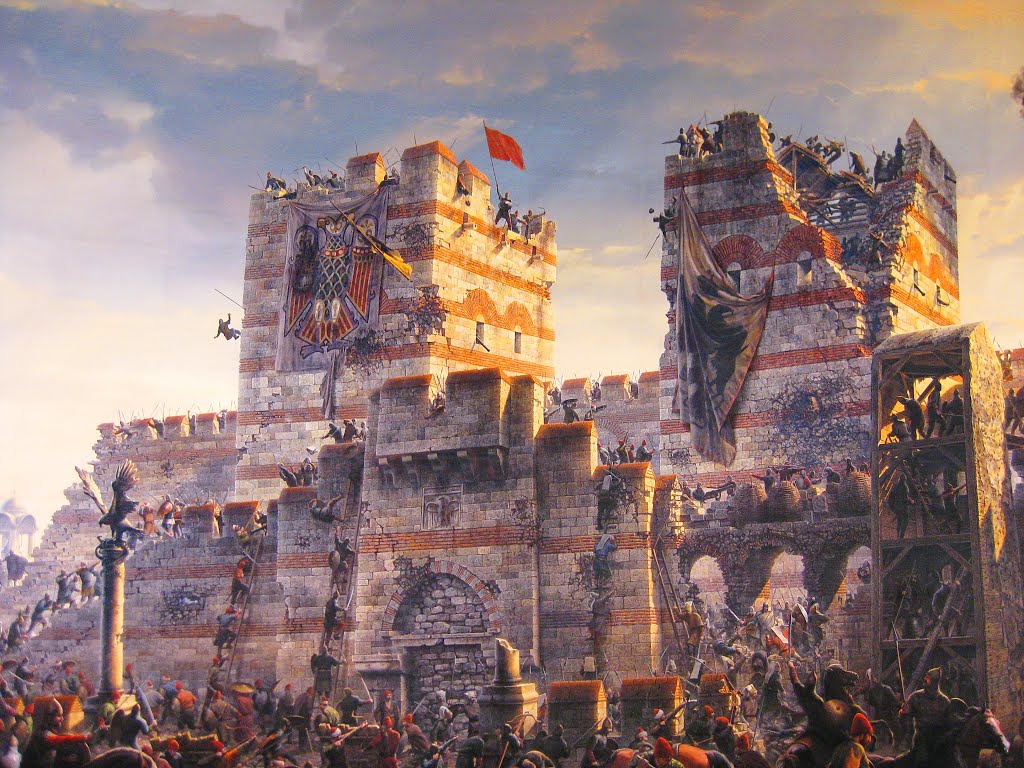
By 1453, Byzantium was an empire in name and memory. It once had been the greatest power in Christendom, extending from Italy to Mesopotamia. Now, it was reduced to a ruined city and a few remnant outposts on the Greek mainland. Its emperors bore a revered title that dated to Constantine, but they wore crowns with paste jewels. Yet, built on an easily defended peninsula , and guarded by the most formidable walls in Europe, Constantinople had defied attack for 1000 years. The Ottoman Turks had conquered the Balkans, but they had learned through past failures to avoid Constantinople.

Mehmed II wanted the imperial city for his capital.  He gathered an army of 80,000 men, nearly twice the size of the population of Constantinople.  His siege equipment included the largest cannons in the world. Furthermore, he created a navy to blockade the port city. Against this force, Constantinople had a garrison of 7000 men, Greeks and their Genoese allies.  Christendom was prepared to mourn Constantinople but not help her. 

Nine years earlier, a Christian army led by the king of Poland and the Prince of Transylvania embarked on a crusade against the Turks.  Their crusade ended at the battle of Varna, when their 20,000 men confronted the Sultan’s 80,000.  By the end of the day, the king of Poland’s head was on a pike, and the rest of his army did not look much better.  (The Prince of Transylvania escaped the Turks, but making his way home was captured and held for ransom by the Prince of Wallachia, a notably nasty fellow named Vlad Dracul.  The Turks probably would have been more gracious.)

Catholic Europe could barely defend herself against the Ottomans; she could not help the Greek Orthodox of Constantinople.  Yet, however much in decline and decay, the city defied conquest.  Its formidable walls withstood the Turks’ onslaught and eight weeks of siege.  Four times the Turks, with their overwhelming numbers, attempted to storm the city; and each effort was a bloody failure.  You can still see headstones of the fallen Janissaries outside the walls of Constantinople.  The Sultan’s engineers attempted to mine the walls; the Byzantines mined the Turkish mines.  You can’t outfox a Byzantine.  In his frustration, and quite contrary to his nature, Sultan Mehmed offered to negotiate.  To us, his terms were not all that generous; he would spare the city if it surrendered.  Keep in mind, however, that his soldiers expected to loot the city.  Sparing Constantinople, the Sultan would be paying off his disappointed horde out of his own coffers.

But Constantinople refused to surrender.  Despite its decline, the old capital still trusted in Heaven’s protection and its imperial destiny.  The Turkish war council was starting to come to the same conclusion but then Heaven seemed to show a Moslem bias.  On May 23, 1453, there was a lunar eclipse, and the Turks were heartened to see a crescent moon matching the one on their flags. 

The fifth attack was on this day in 1453.   Constantine XI, the last Emperor of Byzantium, removed his imperial insignia before leading his men into their last battle.  He would deny the Turks any way of identifying his body and making a trophy of it.  The Sultan attempted to curtail the rampage of his victorious soldiers, protecting the city’s major churches and buildings.  As he instructed his soldiers in the etiquette of looting, “the people are yours but the city is mine.”  Even then, he only allowed his men a full day of looting; after that, Constantinople–and any surviving citizens–were under his protection.

The Sultan was only 21 and he would go on to conquer Serbia and Romania, and he was beginning an invasion of Italy when he died in 1480.  But he is remembered chiefly for taking a decaying old city and then restoring it to its grandeur.  Constantinople indeed did have an imperial destiny, and for the next 450 years it would be the capital of the Ottoman Empire. 

Today the city is known as Istanbul, except on Greek maps.  There the name defiantly remains Constantinople.

The Art of Saving Souls

Posted in On This Day on May 24th, 2009 by Eugene Finerman – Be the first to comment

Today–May 24th– Orthodox Christians honor the Saints Cyril and Methodius.  Roman Catholics would try to be politely indifferent to the hallowed pair, masking a genuine annoyance.  Ecumenicalism has its limits, after all.  Coke does not honor Pepsi. 

In the eighth, ninth and tenth centuries, there was a competition between Rome and Constantinople to see who would convert the pagan Slavs to Christianity. The vying missionaries couldn’t always produce miracles on schedule to win converts, so they often used means that we might find nauseatingly familiar.

The Byzantines tried advertising. However, going door-to-door, they noticed that no one would read their Greek Orthodox religious tracts. The Slavs were illiterate and, even if they weren’t, it is not likely that they would want to read a foreign language. A pair of Byzantine marketing wizards, Cyril and Methodius, made their ad campaign more intelligible by modifying the Greek alphabet to the Slavic tongues. (Cyril and Methodius received sainthoods but Cyril got the glory; the Cyrillic Alphabet is named for him.)

Both Rome and Constantinople sought celebrity endorsements. Their respective salesmen appealed to the local kinglets and chieftains, who would then coerce their respective tribes to salvation. In wooing the petty royalty, the Byzantines had the advantage when it came to bribes: silks and crafted goblets, craftsmanship beyond the ability of those benighted western Europeans. To many a Slavic chieftain, the Byzantine luxuries were unearthly delights and easily seemed proof of Constantinople’s superior faith. That approach sold Russia.

Of course, Rome’s missionaries had their unique offers as well. They often could point to an army of Catholic Franks or Germans just across the border, and who were more than eager to proselytize in their own way. That proved very convincing as well, perhaps even more than silverware and a designer wardrobe.

How To Achieve Infamy

Posted in On This Day on January 26th, 2009 by Eugene Finerman – Be the first to comment

January 25th:

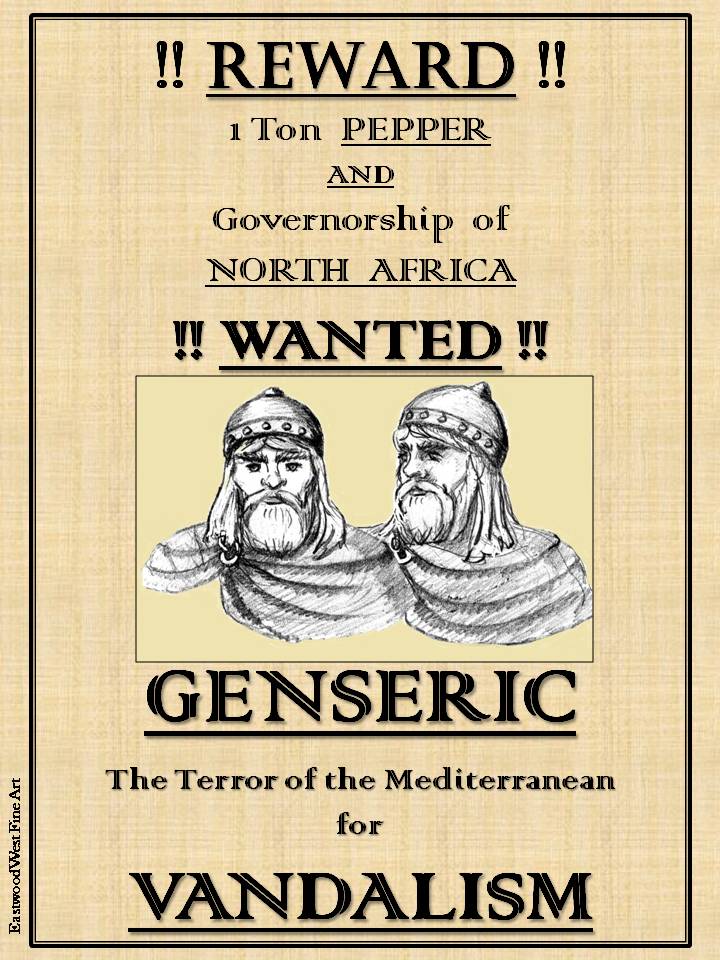
If “Only the good die young,” that would explain Genseric’s long life. He died this day in 477 at the age of 87 or so. We are not quite sure of his actual birthday; being the illegitimate son of a chieftain of a minor barbarian tribe, who noticed? His departure was more conspicuous. After all, by that time he was the King of North Africa, the terror of what was left of the Roman world, and the scourge of the Church. Even today, his legacy lingers. Through his deeds, his tribe is remembered as a felony: Vandal.

Genseric’s career would make a suitable case study for any MBA program. If anyone deserved to be named Entrepreneur of the Fifth Century, it certainly was him. Of course, the early fifth century was a great time to be a barbarian. The Rhine River was all the defense that the Roman Empire had in the West, and it was hardly impassable. (The Germanic tribes waded into the Empire or–to use the Latin pronunciation– in-vade.)

Most of the tribes were competing with one another as to who would loot Gaul. The Vandals, led by Genseric and his annoyingly legitimate half-brother Gunderic, decided to avoid the mob and a losing battle by moving on to Iberia. They were among the first German tourists there. Unfortunately for the Vandals, the Visigoths also heard about Hispania and migrated there, too. Preferring to be the sole barbarians on the peninsula, the Visigoths began wiping out the Vandals. Half of the tribe was gone, and Genseric was now the king of this sorry remnant; in 429, however, the Roman governor of North Africa saved the Vandals. The governor was rebelling against the Emperor and needed mercenaries, so he transported the entire tribe to North Africa.

Ironically, the Roman governor called off his rebellion, but the Vandals didn’t. Genseric liked North Africa; in those days the land was fertile and had not become yet an extension of the Sahara. Prosperous provinces but with meager defenses–what more could Genseric ask! Within ten years, the Vandals occupied the territory extending from Libya to Morocco. (Yes, Rommel’s Afrika Korps was actually the second German invasion there, and the less successful of the two.) Carthage, the capital of Roman North Africa surrendered without a fight; the Vandals occupied the city while most of the populace was at the chariot races.

Genseric’s next venture was piracy. The Vandals proved quite adaptive and quickly developed a fleet that terrorized the western Mediterranean. They conquered the islands of Sicily, Sardinia and Corsica. What could Rome do but flatter him. In 442 the Emperor Valentinian III recognized Genseric as the King of everything he had seized; the official title was supposed to make him behave with regal decorum. Genseric would be further placated by a marriage into the imperial family. The Emperor’s three-year-old daughter was betrothed to Genseric’s oldest (and adult) son; it would be a long engagement. So for the next 13 years Genseric seemed content to administer his realm, restoring to North Africa the stability and prosperity that the disintegrating Roman Empire had failed to maintain. He did tax the patrician landowners and the Catholic clergy (who usually were one and the same) but most of the populace found Vandal rule an improvement.

And Genseric was bored! Although now was in his sixties, he definitely had not mellowed. Yet he felt constrained by his treaty with Valentinian III and the western half of the Roman Empire. True, he was free to attack the Byzantines or his old enemies the Visigoths, but they had the inconvenient capacity to defend themselves; and Genseric really did not like fair fights. However, the life expectancy of a Roman Emperor was rarely long, and Valentinian III made enemies. He was assassinated in March, 455, and two months later Genseric was at the gates of Rome, proclaiming himself the avenger of Valentinian and the protector of his family.

For all his lofty proclamations, his basic demands were “give us everything and no one will be hurt”. Two years earlier, Pope Leo I had persuaded Attila the Hun not to sack Rome; the Pope would not find Genseric to be such a softie. The Visigoths in 410 had sacked Rome, indulging in murder, rape and pillage; but they had refrained from looting churches. The Vandals lacked that sense of etiquette; of course, after the Visigoths, Rome had little left to loot except the churches. Genseric’s sack was bloodless and platonic, but his irrreverent attitude to church property would earn the Vandals their lasting infamy. The medieval monk chroniclers would not forgive the Vandals’ transgression, and their animosity became our perception: VANDALS!. Although usually left to the victor, history is always written by the literate.

Furthermore, despite his agreement with the Pope, Genseric did not strictly observe his pledge of good behavior. Apparently kidnapping was still permissible. No, Genseric was not tacky enough to seize the Pope; but he did take the widow and two daughters of the late emperor. The dowager empress was a Byzantine princess, so Constantinople would be sent the ransom note. Genseric was only offering the widow and one daughter; the other–now nubile–girl was going to marry his son. The ransom negotiations lasted six years. In that time, the Byzantines were hoping that Genseric would succumb to enemies or old age. Both were reasonable expectations but he proved equally adapt at outfoxing his foes and time itself.

In 468, the Byzantines amassed an overwhelming force to crush the Vandal kingdom. More than 1100 ships, with 100,000 soldiers, ascended on Carthage. Unfortunately, the Byzantine emperor appointed his brother-in-law the commander. Genseric offered to surrender and, while the peace terms were being negotiated, the Vandals attacked the lulled Byzantines. Half of their fleet was lost. The idiot brother-in-law returned to Constantinople where he sheltered in a church until the emperor agreed only to exile him.

And the 80 year-old Genseric would outlast another two Byzantine emperors, five Roman emperors and the Western Empire itself. But his kingdom would only survive him by 57 years; he had left his sons an empire but none of the vision or the abilities to preserve it.

Urban Renewal–Byzantine Style

Posted in On This Day on January 11th, 2009 by Eugene Finerman – Be the first to comment

On this day in 532 the citizens of Constantinople protested against a corrupt and tax-loving government by burning down half of their city. The rioters displayed a remarkable unity; they were composed of two political factions–the Greens and the Blues–who usually hated each other. These two parties had evolved from the fans of two competing chariot racing stables; green and blue were the identifying colors of the respective teams.

However, the Byzantine personality (Greek pedantics + Christian theology - Hellenic charm) would not be content with just rooting for a sports team. The fans organized into political parties with vying interpretations of the Trinity. Of course, each interpretation of the Trinity would have a militia to expound it. Between the Greens and the Blues, Constantinople was always on the verge of a riot; but the Imperial government was usually adroit at balancing the factions, playing one off against the other.

The Emperor Justinian should have been a master of this statecraft. He had an amused contempt for mankind and had a genius for cultivating the vices in others; he literally brought out the best in your worst. Appreciating their “talents”, Justinian would appoint thieves to be treasurers, hucksters as diplomats, and elevated an actress to empress. Yet, this wily Emperor misjudged the temper and the patience of Constantinople’s factions.

The two rivals joined forces, and they give their alliance a name: Nika. It is the Greek word for victory. In a week of rage, half of the city was destroyed. Demonstrating their new-found ecumenism, the Nika rioters even burned churches. Yet, the rioters did not attack the Palace. Since the Imperial Guard was content to hide in the barracks and avoid any dangerous exertions such as defending the city, the rioters respected the army’s privacy.

Revelling in their power the rioters now proposed a new emperor, a reluctant but pliant noble named Hypatius. The “old” emperor was free to flee the city: the rioters had left him unimpeded access to the port. Indeed, Justinian was about to take that itinerary. He had called an imperial council of his few remaining supporters to plan the evacuation. However, this ignominious flight was scorned by the Empress Theodora.

Still very much the actress, she declaimed, “For one who has been an emperor it is unendurable to be a fugitive. May I never be separated from this purple, and may I not live that day on which those who meet me shall not address me as mistress. If, now, it is your wish to save yourself, O Emperor, there is no difficulty. For we have much money, and there is the sea, here the boats. However consider whether it will not come about after you have been saved that you would gladly exchange that safety for death. For as for myself, I approve a certain ancient saying that royalty is a good burial-shroud.”

If the Empress was prepared to fight and die for the throne, the men of the court were shamed into being just as heroic. (The court eunuchs probably were still eager to leave.) Although the Imperial army was unreliable, several of the loyal officers had personal retainers who would follow orders. These troops numbered no more than a thousand, but they were an elite force of veterans. The rioters were in the tens of thousands but they were an undisciplined mob and, worse for them, oblivious to the danger. The Nika rioters had gathered at the Hippodrome, the social center of the city. It was a great place for a celebration but an even better place for a massacre.

The Hippodrome’s entrances were all at one end of the stadium. The troops seized the gates and then proceeded to scythe the trapped mob. Thirty thousand were killed; the Nika Riot was crushed. The hapless Hypatius was captured. He pleaded his innocence and Justinian believed him; however, Theodora still insisted on an execution.

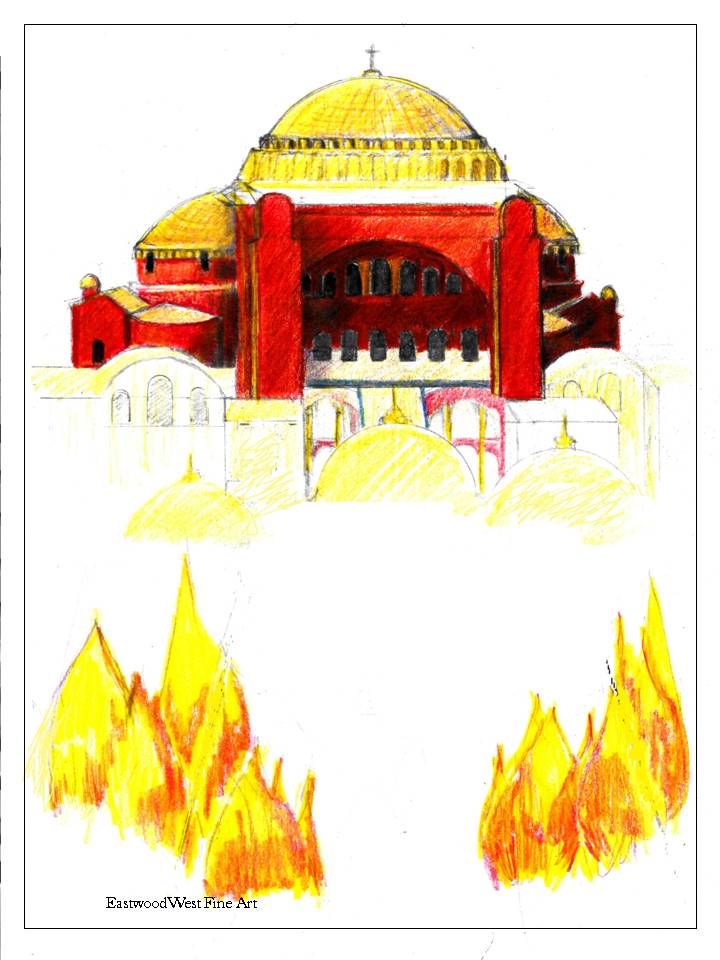
As for Justinian, he did not view the riots as a warning but rather as an opportunity. First, he would have to raise even more taxes to rebuild the city. More importantly, Constantinople now would be rebuilt his way. For example, the rioters had destroyed the old church of Hagia Sophia. Justinian envisioned the new church to be a monument to him.

And it still is.

Apocalypse Then: December 12, 627

Posted in On This Day on December 12th, 2008 by Eugene Finerman – 2 Comments

In 627 a biblical prophecy came true-for a while. Five centuries earlier a Jew-for-Jesus, now remembered as St. John, had predicted a decisive battle between the Empires of the East and the West. The Book of Revelation has been cited as a prediction of the Cold War, September 11th and Rupert Murdoch; however, St. John thought that he writing about Rome and Parthia.

Parthia was Rome’s annoying neighbor to the East. Alexander the Great may have destroyed one Persian empire but with sufficient time and spite the Iranians had created another. Parthia bordered Rome’s Asian provinces and was never shy about raiding them. Of course, Rome retaliated but lost a few armies learning the tactics of desert warfare. The two Empires had already been sparring for a century when John pioneered stream-of-consciousness.

The conflict had lasted nearly two centuries when the Emperor Trajan (53-117) resolved to end it by conquering Mesopotamia. Marching east from Asia Minor, through Armenia (Of course, no one asked the Armenians for permission; no one ever does.) Rome’s army then attacked south along the Euphrates. In a two year campaign (114-115), led personally by Trajan, the Romans conquered Mesopotamia. Unfortunately, the Parthians did not seem to realize that they had been defeated and humiliated. Their forces east of the Tigris were just as annoying as ever. Mesopotamia itself was in continuous rebellion. Trajan died of natural causes-really. The Roman army, hoping to do the same, left Mesopotamia soon after.

And the war continued. Eighty years later, the Emperor Septimus Severus “conquered” Mesopotamia and withdrew two years later. However, the Parthians could hardly feel victorious. Rome had repeatedly sacked their cities but they were in no position to rampage through Italy. Parthia’s leaders realized the futility of their situation and came to one rational conclusion: they needed even more belligerent rulers to fight Rome.

The new dynasty-the Sassanids for you name-droppers-managed to continue the war for another three centuries. Proclaiming themselves as the heirs and avengers of the first Persian Empire, the Sassanids were not merely aggressive and vain; they were lucky. Rome was growing weaker. When the legions were not slaughtering each other in civil war, they were floundering against the barbarian invasions. Rome–divided, diverted and dissipated–could no longer threatened its Iranian nemesis. Indeed, the new Persia was on the attack, rampaging through Rome’s eastern provinces and defeating the legions that Rome could muster. This emboldened Persia demanded tribute and Rome was reduced to paying it.

Byzantium succeeded Rome and continued the policy of appeasement. But if the Byzantines lacked the military resources to thwart the Sassanid empire, they made an art of undermining it. Where there was an idle tribe of barbarians on Persia’s borders, Byzantium would subsidize an invasion. If there were a surplus of Sassanid princes, the Greeks would generously encourage a civil war. Between paying tribute to the Sassanids while subsidizing attacks on them, the Byzantines probably would have found it cheaper to be looted by the Persians.

The Byzantine machinations did achieve a remarkable coup, however. In 590, a deposed Persian king appealed to the Byzantines for support. Always willing to encourage Persian fratricide, the Byzantine Emperor Maurice lent Chosroes II an army and helped restore him to his throne. Chosroes’ response was unusual if not aberrant for a king: sincere gratitude. He established peace between the two kingdoms and dispensed with Persia’s extortion racket. Chosroes, who had overthrown and murdered his own father, behaved like an exemplary son to his Byzantine patron.

And when Maurice was murdered in 602, Chosroes declared war on the usurper: a red-headed and warted miscreant named Phocas. This war was more than the usual Persian exercise in pillage; it was a determined, uncompromising effort to overthrow the usurper. And Phocas certainly was helping the Persians. He executed capable generals, replacing them with idiot relatives. His order to coerce the conversion of Jews set off riots and civil war in the very provinces where the Persians were encroaching. Rather than resisting the invaders, Byzantines were defecting to Chosroes. Persian armies quickly conquered Syria and Asia Minor. The ease of these campaigns convinced Chosroes that he was the rightful successor of Maurice on the Byzantine throne.

However, Chosroes was not the only alternative to Phocas. There were quite a few plots against the usurper, and in 610 one succeeded. The new emperor was Heraclius, and he would live up to his name. His labors included the reorganization of the army, replacing a slapdash, unreliable collection of mercenaries with an uniform system of recruiting, supplying and training an army of Byzantines. This transistion took more than a decade, and during that time the Persians conquered all of Byzantium’s Asian provinces and Egypt. Chosroes now ruled a realm as vast as the first Persian Empire. To his frustration, however, the Mediterranean Sea put up a better defense than Byzantine armies. Since Persia had no navy, Constantinople and her European provinces remained safe.

Chosroes should have realized that he had reached his limits. The Byzantines would have negotiated–after all, they were Byzantines–but Chosroes had become insatiable, mistaking his luck for infallibility. He insisted the war continue, no matter how pointless it had become. He kept an army stationed on the Asian side of the Bosphorus, perhaps waiting for the Mediterranean to dry up.

Chosroes certainly had patience but so did the Byzantines, and they also had a navy. In 622, Heraclius and his new army landed in Asia Minor and began the reconquest. Heraclius had created an army superior to any the Persians could muster. Furthermore, the Emperor gladly entered into unsavory but expedient alliances with Huns and other barbarians. Over the next five years, campaigning in Asia Minor, Armenia (as usual) and Mesopotamia itself, Heraclius’ forces smashed one Persian army after another.

On December 12, 627, near the ruins of Ninevah, Heraclius confronted Persia’s last standing army in Mesopotamia. This would be the decisive battle of the war. Chosroes was not there; his boldness did not extend to personal courage. On the other hand, Heraclius was feeling obnoxiously chipper. When challenged to personal combat by the Persian commander, the 52 year old Emperor accepted. The Persian general must have felt embarrassed to be decapitated by a middle-aged man. And the rest of the Persian army had the same kind of day.

Mesopotamia was at the mercy of the Byzantines. In frustration with Chosroes’ disastrous leadership, rebellion was breaking out in Persia and throughout what was left of the empire. But Chosroes refused to acknowledge the defeat and chaos. The next year his son murdered him. (This was a Sassanid family tradition). Persia then signed an apologetic peace treaty with Byzantium.

Byzantine supremacy would last all of eight years. It had recovered from the Persian invasion but had exhausted its manpower and resources in the effort. The Empire could not withstand a few thousand enthusiastic Arab horsemen who wrested control of Syria, Jordan, Egypt and North Africa. (And they still seem to be the predominant influence there.) Another small but equally zealous Arab force overran what was left of Persia.

So, in the war between Heraclius and Chosroes, Mohammed won.

A Role Model for Blagojevich

Posted in General on December 11th, 2008 by Eugene Finerman – Be the first to comment

Studying history has given me a high standard for scandal. So I am not impressed by a governor attempting to auction off a seat in the U.S. Senate. No, to merit my interest Rod Blagojevich should have offered to sell the entire state. China might want Illinois just for the soybeans. While I would appreciate Blagojevich’s brazenness, I still could not credit him with originality. That same stunt was pulled by King Theodahad in 535 when he offered Italy for sale.

When faced with invasion by a rich enemy, Theodahad’s offer seemed a practical compromise. Even the Italians shouldn’t have minded. At least, the new owner would have a more pronounceable name: Justinian. Besides, Theodahad was not exactly an heroic inspiration–or even a paisan. He was an Ostrogoth, although with a veneer of Roman culture. (Theodahad fancied himself a classical scholar, which by Ostrogoth standards meant he could read.) His uncle Theodoric, leading a barbarian horde, had conquered Italy some 40 years earlier.

Theodoric (454-526) had proved to be an excellent ruler. In fact, he was last competent leader that Italy has had in the last 15 centuries. Unfortunately, his abilty was not hereditary but his monarchy was. Theodoric left the throne and Italy to an idiot grandson who managed to drink himself to death. With his preoccupying vice, the royal sot forgot to have heirs. His mother, Amalasuntha, was Theodoric’s daughter and assumed that she was next-in-line to the throne; she had been the regent during her son’s youth–although that clearly was not a glorious success. However, the Ostrogothic nobility did not like the idea of being ruled by a woman. To placate this barbarian misogyny, in 534 Amalasuntha agreed to share the throne with her cousin Theodahad.

That arrangement lasted only a few months. Although Theodahad had never shown any previous interest in politics, once he was on the throne he wanted the power all to himself. At least Amalasuntha did not seem to mind her ouster. In fact, she was planning a luxurious retirement in Constantinople. As regent and queen, she had been in correspondence with the Emperor Justinian and they had developed a friendship. There were suspicions that Justinian was smitten with the Ostrogothic queen, who was said to be a beautiful, voluptuous blonde. The Empress Theodora–who was a petite brunette–felt the need for her own foreign policy.

The ambassador from Constantinople presented Theohadad with a Byzantine puzzle. Justinian demanded the protection of Amalasuntha, but Theodora wanted a distinctly different form of care for her perceived rival. The Emperor and the Empress clearly had imcompatible aims, and Theohadad was in a hopeless position. Whatever he did, he would have an enemy and a war. The Byzantine ambassador confided this advice to Theohadad. Justinian would be the more congenial enemy; at least, he might forgive. Soon after, Amalasuntha died her in bath–strange accident.

Theohadad planned for the inevitable war by negotiating the surrender. Once the Byzantines landed in Italy, he would cede the kingdom in return for a yearly income of 1200 pounds of gold. (That would be the equivalent of 15 million dollars.) Of course, Theohadad did not mention his plans to the Ostrogoth army. So the commanders were surprised that the King did not respond when the Byzantines conquered Sicily in 535 and then invaded Southern Italy the next year. As the Byzantines moved north, the Ostrogoth generals simply decided to mobilizee the army without Theohadad’s permission. And if they could ignore him, they might as well oust him. A cousin-in-law replaced him. The Ostrogoth nobles never knew of Theohadad’s treason (the Byzantines could keep a secret); they just despised him as an incompetent and a coward.

You already know the mortality rate among deposed Ostrogoth rulers. In Theohadad’s case, no one pretended it was an accident. The Byzantines would eventually conquer Italy but it took 19 years. The long war would destroy the Ostrogoths, exhaust the Byzantines and ravage Italy. Perhaps a simple if unethical sale would have been preferable…and a bargain.

A Frustrated Princess Makes A Great Historian

Posted in On This Day on December 1st, 2008 by Eugene Finerman – 5 Comments

Of course, the Emperor Alexius I would have preferred a son. But, knowing Byzantine women, he had no doubt that his infant daughter Anna would have a natural affinity for power. Yes, she would need a husband for propriety’s sake, but she would be perfectly capable of ruling through her hapless mate. So Anna Comnena, born December 1st in 1083, received the education and attitudes of an empress. By the time she was four, the princess knew her place in the world–at its apex.

But then the future Empress was undone by an act of treachery: the arrival of a little brother. Through the accident of gender, this unaccomplished infant replaced Anna as the heir to the Empire. Worse, this usurper had the further affrontry to survive the usual childhood diseases; Prince John grew to become a pleasant, dutiful if bland young man. There was nothing about him his sister could slander. Nonetheless, having a Byzantine aptitude for conspiracy, Anna did her best to disinherit her brother. The women in the royal family, including the Empress, sided with the dynamic Anna over the dull John. However, the Emperor Alexis had the final word and it was on his death bed. While his imminent widow and indignant daughter begged that the throne pass to Anna, the dying Emperor anointed his son.

As the ruler of Byzantium, John had to contend with invading Turks, encroaching Crusaders and a
relentless sister; but only one of those three wanted him dead. And Anna wasn’t wasting time. The first assassination attempt was at their father’s funeral, but the Emperor was warned in time. Anna next choreographed a coup and murder at the summer palace. The conspirators assembled there, awaiting a signal from Anna’s husband. (Yes, Anna succumbed to that social expectation.) However, her husband decided that he actually liked the Emperor–certainly less frightening than Anna–and foiled the plot.

Something had to be done about Anna; she was impossible to ignore. The Emperor would have been entitled to execute his sister or at least subject her to the mutilations that were a Byzantine specialty. (Eyes, nose, tongue–when you lost face in Constantinople, it was literal.) But drab John also was remarkably merciful. He was content to have Anna banished to a comfortable convent for the rest of her life. Of course, John also knew that a sedentary existence would be the ultimate torture for his dynamic sibling

She would spend her remaining 35 years in that convent; but if Anna was banished from the Court, the politics and the glory, she found a way to relive it all. In fact, she attained a greatness that she might never have achieved on the throne. In her confinement, Anna wrote the definitive history of her era: “The Alexiad.” The chronicle of her father’s reign, it relates the history of the Byzantine Empire and the First Crusade from the unique and invaluable perspective of a member of the imperial family. Her account of the Crusaders is especially edifying. Through Anna, we know the Byzantine reaction and attitude to their dismaying and quite unwelcome allies: the Crusaders were more barbaric than the Turks and just as dangerous.

But it is Anna’s personal anecdotes and insights that distinguishes “The Alexiad” among histories of the period. The young princess saw, heard and all-too-often smelled the leading figures of the Western armies as they passed through Constantinople and imposed themselves on the Byzantine Court. Even after the passing of decades, the middle-aged writer still nursed a teenage crush on one of those fascinating barbarians: the tall, handsome and dangerous Bohemund of Sicily…”He had about him a certain charm…there was a hard, savage quality in his aspect–owing I suppose to his great stature and to his eyes: even his laugh sounded like a threat to others.

(That was written 8 centuries before Judith Krantz and Barbara Steele. No, the rest of “The Alexiad” is not as racy; otherwise, it would have been made into a movie by now.)

If Anna had become Empress, she would have been just a medieval Arianna Huffington. They were common enough in Byzantine history. In failing, however, Anna attained a greatness that eclipses her brother’s claim in history. Yes, he was the Emperor–and a good one–but he is best remembered for being the brother of Anna Comnena.